

Inside Washington: September 2026
Jump to:
Senate Negotiators Reach Bipartisan Permitting Deal; First Vote Set for November 9
Ratepayer Protection Act Clears House, Stalls in Senate
Trump Announces $200 Billion in South Korean Energy Projects, Extends China Truce
Change Order Payment Bill Clears Committee 23 to 0
Congress Examines the Back End of the Nuclear Fuel Cycle
NECAPAC Convention Recap
Thank you to everyone who stopped by the NECAPAC booth last week! The Government Affairs team enjoyed connecting with contractors and staff from across the country and discussing the latest developments in Congress.
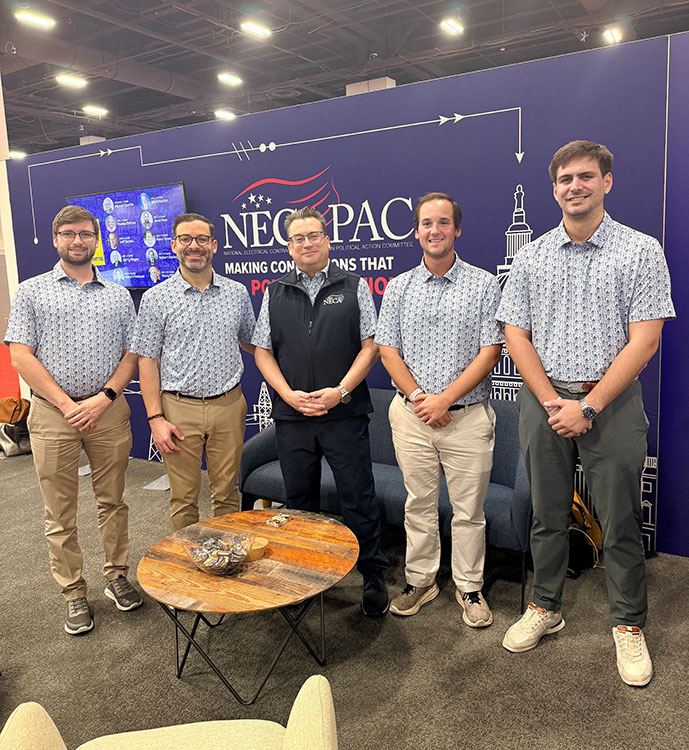
With your help, we were able to raise over $200,000 between the Swingin’ September Sweepstakes and the 2026 Convention. A special THANK YOU to those who renewed their PLC contribution:
- James Bane: Mon Valley Electric
- Jeff Barber: VEC Electric
- Ken Bauwens Jamerson & Bauwens Electric
- Mike Boggs: Boggs Electric Co.
- Kurt Brinkman: Intrepid Electronics
- Henry Brown: Miller Electric
- Ron Cogburn: Cogburn Brothers
- Chandler Crews: Cogburn Brothers
- William Darish: Industrial Electric
- Jimmy Feazel: Feazel Electric
- Robert Fimbianti: Electric Plus
- Brian Gini: Collins Electric
- Eugene Gini: Collins Electric
- Kevin Gini: Collins Electric
- Doug Herring: Motor Shop Electrical Construction
- Greg Long: Long Electric
- Patrick Maloney: Tice Electric
- Mark Mazur: MJM Electric
- Todd Mikec: Lighthouse Electric
- Eric Nixon: Maron Electric
- Rick Osbakken: Holden Electric
- Greg Outsen: Outsen Electric
- Michael Parkes: O’Connell Electric
- Jeff Restine: Fuller Electric
- Earl Restine III: Fuller Electric
- Carson Rogers: Chewning & Wilmer
- Evan Rogers: Chewning & Wilmer
- Robert Turner: Turner Electric
- Vanessa Tutos: Quanta Services
- Collin Weiner: CalEnergy
- Tim Whicker: Electric Plus
Registration for the 2026 PLC Retreat is open! If you haven’t secured your spot, there’s still time to join us on Alabama’s Gulf Coast November 6-8. You won’t want to miss our Midterm Election recap with author, TV personality, and pollster Kristen Soltis Anderson. We’ll unpack what happened, what it means for Congress, and how it sets the stage for the 2028 presidential election.
Contact Seth Guidry ([email protected]) or Emily Palm ([email protected]) for registration information and we look forward to seeing y'all there!
From The Grand: We are happy to share that the Queen of Southern Resorts continues to reign over Mobile Bay. Our team is safe, and Hurricane Isaias did not damage the historic Grand hotel.
Senate Negotiators Reach Bipartisan Permitting Deal; First Vote Set for November 9
Senate negotiators released a bipartisan permitting package on September 30, hours before the chamber left Washington for the election recess. The Bipartisan American Affordability and Jobs Act was negotiated by Sens. Mike Lee (R-UT), Martin Heinrich (D-NM), Shelley Moore Capito (R-WV), and Sheldon Whitehouse (D-RI). The first procedural vote is scheduled for November 9, the day Congress returns.
The bill would set a 150-day deadline for lawsuits challenging permits, send flawed environmental reviews back to agencies for correction rather than voiding the permit, and bar agencies from revoking permits already issued except in cases such as legal violations or fraud. On transmission, it would expand FERC’s backstop siting authority for interstate lines and direct FERC to write rules so data centers, not other customers, pay for the transmission built to serve them.
The deal came together after the White House signaled it would move forward on previously approved wind and solar projects, one of the issues that stalled talks for months. Democrats still want firmer assurances before the vote, and the House passed its own, narrower SPEED Act in December which does not include transmission, so the two chambers would still need to reconcile their bills.
Permitting reform has been NECA’s top priority in Washington, and NECA welcomed the agreement as an important step toward fixing the nation's lengthy permitting process. Better transmission planning and siting, more certainty and accountability in permitting decisions, and faster interconnections would help move projects from the planning table to construction.
The Government Affairs team is reviewing the bill text and will stay engaged with stakeholders ahead of the November vote.
Ratepayer Protection Act Clears House, Stalls in Senate
On September 16, the House passed two bills with direct stakes for the grid buildout before leaving for October recess.
The Ratepayer Protection Act (H.R. 9340) passed 417 to 3. It would require state utility commissions and nonregulated utilities to consider a federal standard under which data centers with aggregate peak demand of 100 megawatts or more at a single site or campus would pay the full cost of the generation, transmission, and distribution upgrades needed to serve them. The standard would also call for financial assurances up front, protecting other customers if a project is delayed or canceled.
The High-Capacity Grid Act (H.R. 6633), a NECA transmission priority introduced by Rep. Julie Fedorchak (R-ND), passed unanimously on September 15. It would direct FERC to set a best-available conductor standard for new and rebuilt interstate transmission lines, so utilities get more capacity out of existing rights-of-way.
The Ratepayer Protection Act did however run into trouble in the Senate. Sen. Martin Heinrich (D-NM) objected to fast-tracking it on September 17, arguing data centers should be required to pay rather than states merely asked to consider it. On September 30, a procedural vote fell three short of the 60 needed, 57 to 43. The bill is stalled until Congress returns in November.
Still, the votes put both parties on record that large loads should pay their own way. For NECA contractors, clear cost rules are what keep interconnection projects financeable and on schedule.
Trump Announces $200 Billion in South Korean Energy Projects, Extends China Truce
On September 30, President Trump announced up to $200 billion in South Korean-backed energy projects in the United States, the first wave of the $350 billion Seoul pledged under last year’s trade deal. The package includes a $120 billion program to build eight large nuclear reactors and a $22 billion, 6.4-gigawatt natural gas plant in Encinal, Texas, to supply data centers and semiconductor plants. It also lists $54 billion for the Alaska LNG pipeline, though Seoul says that piece is not final.
A week earlier, the President hosted Chinese President Xi Jinping at the White House, and the two sides extended last fall’s trade truce by two months, to January 10. The truce keeps tariffs lower and rare earth exports flowing while larger disputes remain unresolved.
For NECA contractors, eight reactors and a 6.4-gigawatt plant would mean years of large-scale electrical construction. The truce keeps rare earth minerals flowing for the transformers, motors, and switchgear already in short supply.
Change Order Payment Bill Clears Committee 23 to 0
On September 16, the House Small Business Committee unanimously advanced the Small Business Payment for Performance Act (H.R. 4615), introduced by Rep. Pete Stauber (MN-08) with Reps. Marc Veasey (D-TX), Brian Fitzpatrick (R-PA), and former IBEW electrician Donald Norcross (NJ-01).
When a federal contracting officer orders a change in the work, the contractor has to perform it and carry out the cost, often for months, while the final price is negotiated. Under the bill, a small business that submits a proper request would receive an interim payment of at least 50 percent of the estimated cost after agency review, with a share passed through to first-tier subcontractors.
For NECA members on federal jobs, payroll and materials would no longer sit unpaid while a change order works through the system. The bill awaits House floor time in November.
Congress Examines the Back End of the Nuclear Fuel Cycle
Two September hearings put spent nuclear fuel back on the agenda as the Department of Energy advances its proposed Nuclear Lifecycle Innovation Campuses. The campuses would co-locate fuel fabrication, enrichment, reprocessing, and waste disposition, potentially alongside advanced reactors, manufacturing, and data centers. DOE says a single campus could draw up to $50 billion in investment and nearly 25,000 jobs.
Utah, Tennessee, Oklahoma, Louisiana, and Idaho signed agreements with DOE in July to explore hosting a campus. West Virginia joined in September but withdrew on September 30, the deadline for binding host agreements, citing concerns about accepting out-of-state spent fuel.
On September 15, the House Energy and Commerce Subcommittee on Energy heard from DOE Assistant Secretary Theodore Garrish, the Nuclear Energy Institute, state regulators, and plant owners, calling expanded reprocessing long overdue. On September 23, the Senate Environment and Public Works Committee took up updates to the Nuclear Waste Policy Act, where witnesses noted that reprocessing can recover about 90 percent of the energy left in spent fuel but would not eliminate the need for permanent disposal.
According to DOE, more than 95,000 metric tons of spent fuel is stored at 79 sites in more than 30 states. The federal government has already paid $12.2 billion in damages for failing to take it, and DOE estimates future liability of up to $44 billion.
For NECA contractors, each campus would be a long-term construction program, and resolving the waste question would remove one of the biggest obstacles to nuclear buildout. These facilities would also need electricians trained to nuclear quality standards, and NECA chapters and JATCs are where that workforce starts.
Capitol Competition Update
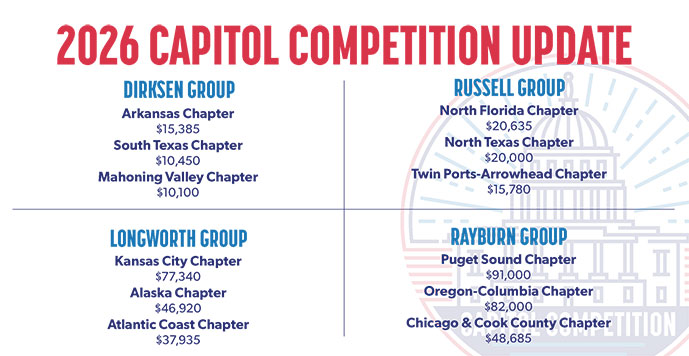
Chapter Managers and PLC Representatives, keep an eye out for PLC Chapter Goal updates from Seth in the coming weeks and remember contributions must be received by Dec. 18, to be counted toward this year’s competition.