

Inside Washington: June 2026
Jump to:
NECA Holds Inaugural District 10 Fly-In
Citadel Electric Group Hosts Rep. Derek Schmidt and Congressional Candidate Chris Stigall
House Energy Subcommittee Marks Up Eight Bills to Lower Electricity Costs
House Education and Workforce Examines the Apprenticeship Pipeline
House Passes Four Grid Security Bills
DOT Sends $1.86 Billion to Repair Storm-Damaged Infrastructure
NECA Holds Inaugural District 10 Fly-In
NECA hosted its inaugural D10 Fly-In on June 23-24, bringing 25 outside line contractors from across the country to Washington for two days of advocacy — and for more than half of attendees, it was their first NECA Advocacy event.
Contractors spoke with Congress on the priorities that matter most to the outside line industry, including permitting reform and expanding the nation's transmission system. Expediting the permitting process is needed to get new lines and rebuilds approved on a realistic timeline, and growing transmission capacity is critical to meeting rising electricity demand.
.jpg?sfvrsn=5a49f84a_1)
Day 1 of the visit kicked off with Rep. Julie Fedorchak (R-ND) stopping by NECA HQ to share her background as a utility regulator — before Congress, she spent twelve years on the North Dakota Public Service Commission, where she oversaw electric utilities and transmission siting and permitted more than $15 billion in energy infrastructure projects — and to walk members through her High-Capacity Grid Act (H.R. 6633), which would direct FERC to set a best-available conductor standard for new interstate lines and rebuilds. This was followed by three Members of Congress, Reps. Don Norcross (D-NJ), Russell Frye (R-SC), and Dina Titus (D-NV), stopping by at breakfast on Day 2 to discuss how contractors can help inform Members of Congress.
From there, members spent the rest of their time in productive meetings with key Members of Congress who sit on the Committees shaping the industry's future, including Energy and Commerce, Transportation and Infrastructure, Ways and Means, and Education and Workforce. These Committees pass legislation on grid and transmission policy, infrastructure investment and permitting, and the apprenticeship programs that train the line workforce — giving District 10 a direct line to the offices that will determine the future of American energy.
.jpg?sfvrsn=82738d13_1) | .jpg?sfvrsn=e8ea8098_1) |
Citadel Electric Group Hosts Rep. Derek Schmidt and Congressional Candidate Chris Stigall
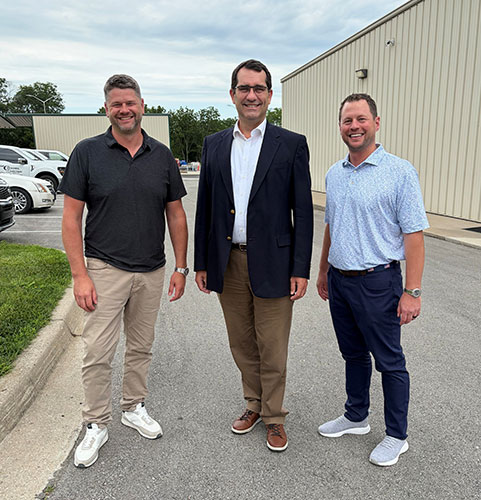
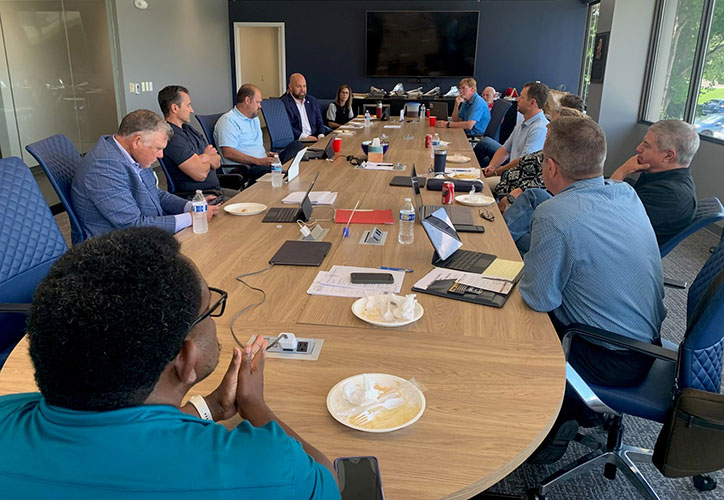
On June 18, Citadel Electric Group welcomed Rep. Derek Schmidt (KS-02) and Missouri 6th District congressional candidate Chris Stigall to its Oak Grove facility for a tour and discussion with company leadership.
The visit gave both a close look at the work Citadel performs on major infrastructure and federal projects across the region and opened a direct conversation about the issues facing the industry.
 |  |
"Our team was proud to show Congressman Schmidt and candidate Chris Stigall how NECA contractors like Citadel are supporting national infrastructure and critical federal facilities, including Fort Riley, Fort Leavenworth, Whiteman Air Force Base, and area VA hospitals. These conversations matter because the issues facing our industry, data center construction, labor shortages, workforce development, federal project delivery, and retainage tax fairness, directly affect our ability to build, hire, and deliver for our customers," - Marc Tower, President, Citadel Electric Group.
NECA thanks Rep. Schmidt and Mr. Stigall for taking the time to meet with our members and see the critical role electrical contractors play across the region.
House Energy Subcommittee Marks Up Eight Bills to Lower Electricity Costs
On June 24, the House Energy and Commerce Committee considered eight bills aimed at lowering electricity costs for households and strengthening the grid. Energy Subcommittee Chairman Bob Latta (OH-05) framed the package as a response to a reliability crisis and to affordability pressures straining household budgets, while keeping the U.S. competitive with China on AI development.
The bills advanced to the full committee and include the Load Forecasting Enhancement Act (H.R. 9332), the Affordable Innovation for the Grid Act (H.R. 9339), the Advanced Transmission to Reduce Rates Act (H.R. 9335), the Ratepayer Protection Act (H.R. 9340), the High-Capacity Grid Act (H.R. 6633), the Protecting Families from AI Data Center Energy Costs Act (H.R. 6529), the Expediting Generator Interconnection Procedures Act (H.R. 2986), and the Pipeline Safety Authorization Act of 2026 (H.R. 9338).
Advanced transmission technology, higher capacity grid lines, and faster generator interconnection all require the construction and upgrades NECA members perform. As load growth from data centers and electrification continues, the package signals sustained demand for transmission and grid infrastructure work.
House Education and Workforce Examines the Apprenticeship Pipeline
On June 24, the Subcommittee on Higher Education and Workforce Development held a hearing titled "Workforce Rewired: Modern Apprenticeships for a Modern Economy." Subcommittee Chairman Burgess Owens (UT) opened by noting that an estimated 40 percent of the skills required for today's jobs will change over the next decade, driven by AI, raising the need for workers to upskill and reskill on the job.
Witnesses described apprenticeships as a practical hiring pipeline for industries facing technician shortages and as a path to stable, high-paying careers without student debt. The demand signal for the electrical trade was front and center, with testimony pointing to a need for roughly 80,000 electricians alongside a national push toward one million active apprentices.
For NECA contractors, the hearing reinforced what members see on every job, that the skilled electrical workforce is the constraint on meeting surging demand for power. Registered apprenticeship remains the proven model for building that workforce and continued federal attention to earn-and-learn pathways supports the pipeline NECA members depend on.
The Government Affairs team submitted five questions for the record, including relating to the importance of mentorship in employee retention and the value of NECA’s training model.
House Passes Four Grid Security Bills
On June 29, the House passed four bipartisan bills to harden the electric grid and strengthen its defenses against cyber and physical threats.
- The SECURE Grid Act (H.R. 7257) directs states to account for the physical security, cybersecurity, and resilience of local distribution systems in their energy security plans.
- The Energy Emergency Leadership Act (H.R. 7258) places the Department of Energy's energy emergency and cybersecurity functions under dedicated Assistant Secretary leadership.
- The Rural and Municipal Utility Cybersecurity Act (H.R. 7266) reauthorizes the grant and technical assistance program that helps rural cooperatives and small utilities defend their systems, funded at $250 million per year through 2030.
- The Energy Threat Analysis Center Act of 2026 (H.R. 7305) reauthorizes for five years the center that coordinates threat detection and intelligence sharing between grid operators and the federal government.
Hardening substations and distribution systems, integrating physical and cyber protections into grid infrastructure, and upgrading the equipment smaller utilities rely on all call for skilled electrical construction. As Congress pushes resources toward grid security, NECA contractors are positioned to build and maintain the protected infrastructure that these measures envision.
DOT Sends $1.86 Billion to Repair Storm-Damaged Infrastructure
On June 18, the Department of Transportation announced $1.86 billion in emergency relief funding to help states repair roads, bridges, and other transportation infrastructure damaged by recent natural disasters. More than $908 million is directed to Hurricane Helene recovery, bringing the Federal Highway Administration's total Helene commitment to $3.4 billion, with $2.9 billion to North Carolina alone.
The remaining balance supports repairs tied to 2024 flooding and mudslides, 2025 storms and flooding in Arizona, atmospheric river events across the West, and other disasters. The package also includes $300 million connected to the March 2024 Francis Scott Key Bridge collapse in Baltimore.
For NECA contractors, large-scale infrastructure rebuilds rarely stop at roads and bridges. Restoring damaged corridors brings power, signals, lighting, and grid components back online alongside the civil work, and the federal dollars moving out the door point to continued rebuilding activity in storm-affected regions.