
Inside Washington: February 2026
Jump to:
Trump's State of the Union Highlights Urgent Need for Electrical Infrastructure
Construction at JFK: A Spotlight on NECA Contractors
House Passes Legislation to Secure America's Energy Supply Chains
Permitting Delays Put Grid Reliability and Wildfire Safety at Risk
NECA Legislative Conference 2026
Trump's State of the Union Highlights Urgent Need for Electrical Infrastructure
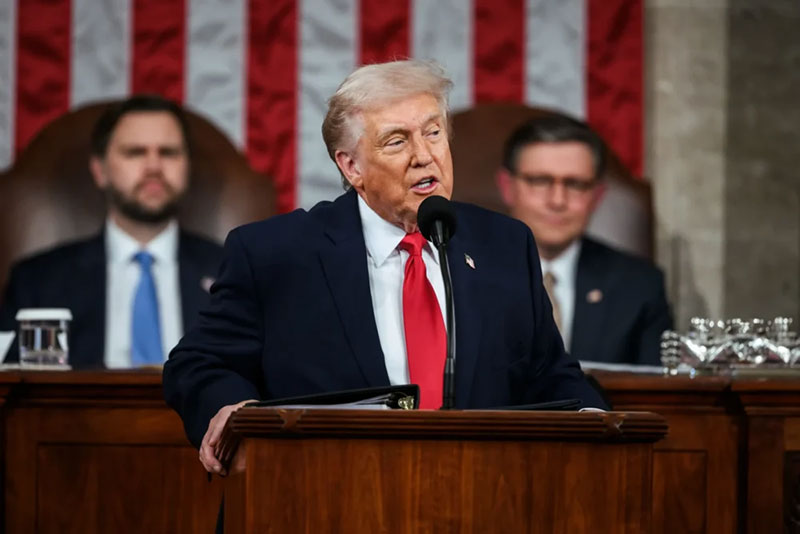
On February 24, President Trump placed energy reliability and grid modernization front and center, signaling continued opportunity for NECA contractors.
The most significant announcement for the electrical industry was Trump's unveiling of a "Ratepayer Protection Pledge" aimed at preventing AI data center demand from driving up residential electricity bills. The President declared that major tech companies would be required to generate their own power, saying the nation has "an old grid" that "could never handle the kind of numbers, the amount of electricity that's needed." This framing reinforces what NECA members have heard from FERC and Congress for months: the grid is under stress and needs to be rebuilt and expanded, not just maintained.
Nuclear Revolution
The President's remarks on nuclear energy reflected his Administration's aggressive posture toward domestic nuclear expansion. The Department of Energy has already committed $2.7 billion to strengthen domestic uranium enrichment and has set a target of expanding U.S. nuclear capacity from roughly 100 GW today to 400 GW by 2050. That kind of buildout will require significant transmission infrastructure, control systems, and grid interconnection work.
The speech also came on the heels of a $26.5 billion DOE energy grid loan announced this week, the largest in Department history, directed at adding over 16 gigawatts of new generation capacity across the South. The Administration framed the investment as essential to keeping electricity affordable and the grid reliable as manufacturing reshoring and data center construction accelerate.
Construction at JFK: A Spotlight on NECA Contractors
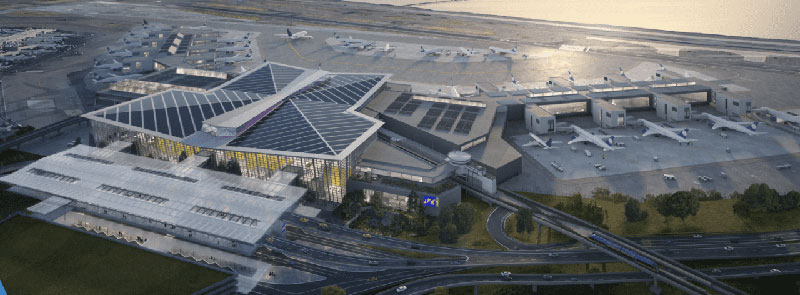
JFK International Airport is undergoing a $19 billion modernization, and NECA contractors are playing a critical role in bringing it to life. The project is the largest electrical construction project in New York City history, with over 1,700 IBEW Local 3 electricians working across 15 NECA contractors.
_3.jpg?sfvrsn=d93f34ff_1)
EJ-Electric is installing a 6.63-megawatt rooftop solar system on the new Terminal 1, the largest at any airport terminal in the United States, along with fuel cells that generate electricity, hot water, and chilled water for the facility. Together, these systems form the backbone of what is expected to be the largest self-contained airport microgrid in the country.
Lion Heart Electric is installing electrical infrastructure for the terminal's automated baggage handling system, a data-driven network designed to streamline baggage movement throughout the facility.
The terminal's first gates are expected to open in mid-2026, and JFK is just a snapshot of the broader opportunity ahead. From AI data centers to nuclear facilities to major transportation hubs, the demand for what NECA contractors do every day has never been greater, and our members are proving it on one of the biggest job sites in the country.
House Passes Legislation to Secure America's Energy Supply Chains
On February 11, the House passed H.R. 3617, the Securing America's Critical Minerals Supply Act, sponsored by House Energy and Commerce Committee Chairman Brett Guthrie (KY-02) and Rep. John James (MI-10) and advanced through the House Energy and Commerce Committee. The bill requires the Department of Energy to assess vulnerabilities in critical energy resource supply chains and take steps to reduce dependence on adversarial nations, particularly China.
- The U.S. is 100 percent reliant on imports for 16 critical minerals
- An additional 50 vital mineral commodities see 50 percent import reliance
- China controls 60 percent of global rare earth production and 90 percent of global processing capacity
For NECA contractors, the minerals at risk are not abstract. Copper, aluminum, and rare earth elements are essential components in transformers, switchgear, transmission infrastructure, and the advanced grid technologies needed to support surging electricity demand. The bill now heads to the Senate, where NECA will continue to monitor its progress.
Permitting Delays Put Grid Reliability and Wildfire Safety at Risk
On February 24, the House Natural Resources Subcommittee on Water, Wildlife and Fisheries held an oversight hearing examining how federal land management bottlenecks are driving up electricity costs and leaving communities exposed to catastrophic wildfire. The stakes are concrete, as some 90,000 miles of transmission lines cross Forest Service and Bureau of Land Management properties nationwide, and delays in maintaining that infrastructure have real consequences.
Chairwoman Harriet Hageman (WY-01) opened the hearing directly, stating that "bureaucratic red tape puts our livelihoods and electric grid at risk" and that "inconsistent and drawn-out permitting drives up electric bills and leaves communities vulnerable to catastrophic wildfire."
Witness testimonies further backed the claim by providing real world examples happening in the industry today:
Jason Bowling, CEO of Sulphur Springs Valley Electric Cooperative in Arizona, described a routine pole replacement along an established corridor that took fifteen years to permit before wrapping up construction in weeks. His summary was blunt. "Prevention took weeks. Permitting took years."
George Arhos, a nearly 30-year IBEW journeyman lineman, reinforced that message from the field. "These delays are not just bureaucratic inconveniences. They increase wildfire risk and drive up electricity costs."
Christina Hayes of Americans for a Clean Energy Grid added that grid delays carry a measurable human cost, noting that during Winter Storm Fern, an additional 1 gigawatt of transfer capability across PJM would have saved $109 million in power costs during the storm's peak.
The Bottom Line
Witnesses unanimously agreed that in order to protect the grid and prevent surging electric costs, the Senate needs to advance the Fix Our Forests Act (H.R. 471), which passed the House in January 2025 with a strong bipartisan margin of 279 to 141. The bill would expand hazard tree removal authority from 10 feet to 150 feet of power lines, establish automatic plan approval after 120 days, and reduce the environmental review burden for routine maintenance work on federal lands. NECA's Government Affairs team will continue to monitor the bill's progress as it awaits a Senate floor vote.
Will We See You in DC?
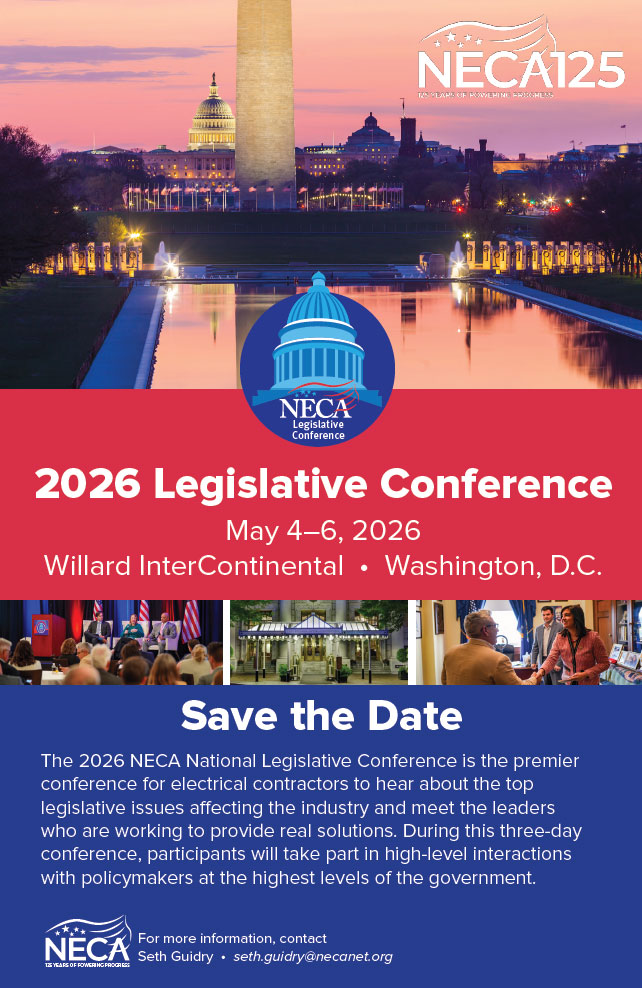
Registration is NOW OPEN for the 2026 NECA Legislative Conference – the electrical construction industry's premier advocacy event. Join NECA contractors and chapter staff from across the country at the historic Willard InterContinental Hotel to discuss the latest legislative and regulatory developments shaping our industry.
When: May 4-6, 2026
Where: Willard Intercontinental – Washington, DC
Click Here for more information.
Never been before? We've got you covered. We're offering a dedicated first-time attendee session that gives you everything you need to have productive, meaningful meetings with your elected officials.